
The Fundamentals
Layering Essentials for the Modern Gentleman
Three pieces, one silhouette. How to build a layered look that breathes through the seasons without ever losing its line.
4 min read · Published August 2026
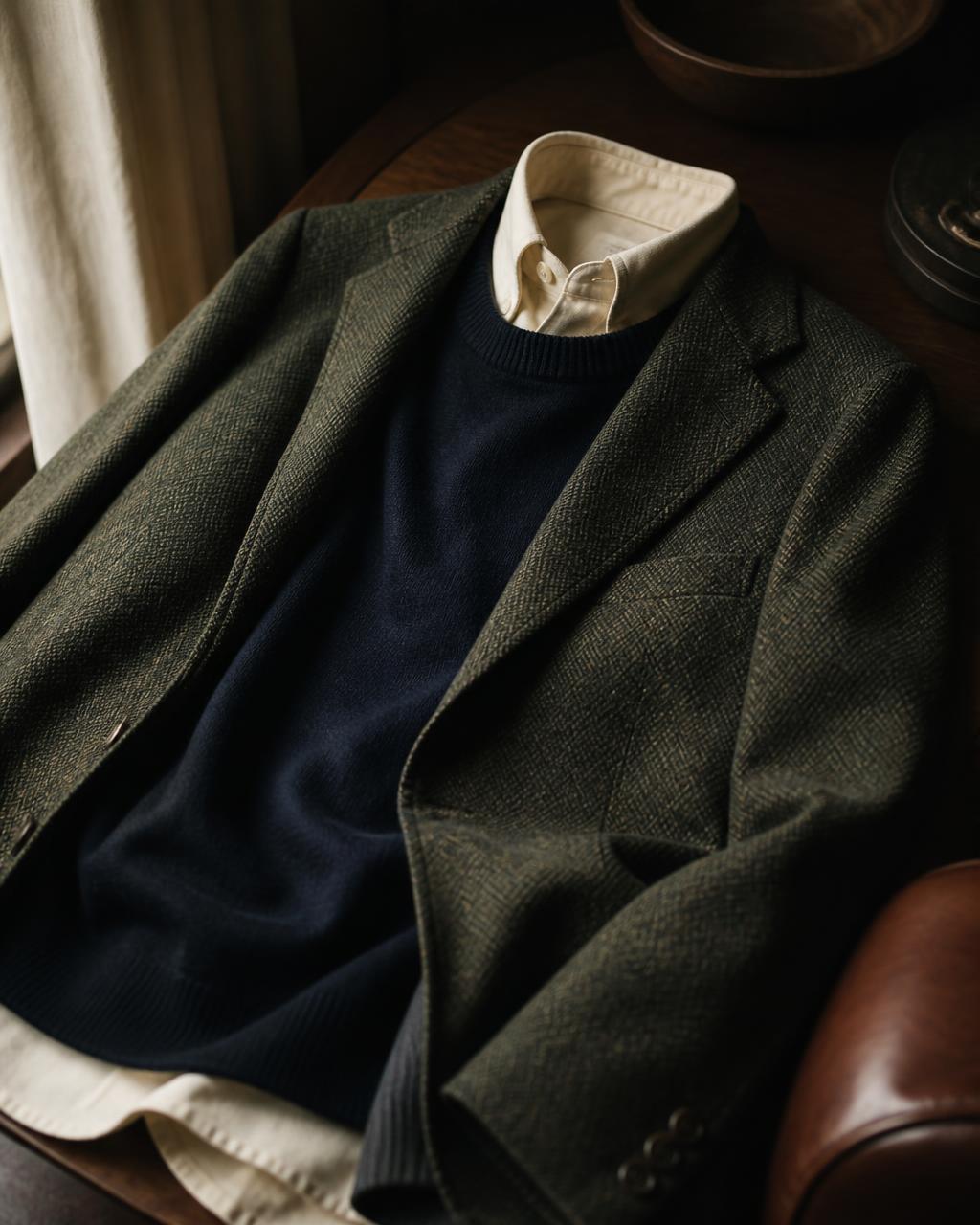
Most men layer by addition. A cold morning arrives, another garment goes on, and by the time the day warms up the silhouette has collapsed into bulk. Proper layering is the opposite discipline: it is subtraction planned in advance. You decide the shape first, then choose pieces thin enough that the shape survives all three of them at once.
The three layers, in order
Everything worth wearing in a temperate climate reduces to a base, a middle, and a shell. Get the roles right and you can dress for a forty-degree swing without carrying a bag.
The base sits against you and does the quiet work. An oxford cloth button-down, a fine poplin shirt, a long-sleeve cotton knit. It should be trim through the body — not tight, but close enough that a sweater over it doesn't produce ripples at the waist. This is where the Covert Shirt earns its keep: a collar with enough structure to stand on its own under a crewneck, which is the single most common failure point in a layered look.
The middle is the insulator and the color. A fine merino crewneck, a quarter-zip, a lambswool v-neck. The rule here is gauge, not warmth — a chunky knit under a jacket is the fastest way to look padded. Fine-gauge merino gives you most of the warmth at a third of the volume, which is why the Paddock Pullover is cut to disappear under a coat rather than fight it.
The shell sets the register of the whole outfit. A tweed sport coat reads considered. A waxed field jacket reads country. A Barnsley Harrington reads easy without reading careless. Whatever you choose, it must close comfortably over the middle layer — a shell you can only wear open is a shell that has failed at its one job.
Weight descends, never ascends
The cardinal error is a heavy layer trapped beneath a light one: a thick shawl-collar cardigan under an unlined blazer, for instance. The eye reads the outer garment as strained, because it is. Weight and structure should increase as you move outward — fine against the skin, substantial on the outside. Follow that one rule and most layering problems resolve themselves without further thought.
Three tones, maximum
Layering multiplies the number of colors visible at once, which is precisely why restraint matters more here than anywhere else in dressing. Hold yourself to three tones across the whole outfit and let one of them repeat. Cream shirt, navy knit, olive coat — three tones, brown leather picking up the warmth of the tweed. The look coheres because nothing in it is competing for attention.
If you want a fourth element, make it a texture rather than a color. A herringbone against a flat merino against a smooth poplin gives the eye plenty to read while the palette stays quiet. This is the same principle we apply to the old money aesthetic — interest through cloth, not through contrast.
Let something show
A layered outfit should announce that it is layered. A quarter-inch of shirt cuff past the coat sleeve, a collar sitting clean above the knit's neckline, a shirt hem never dropping below the sweater. These small reveals are the whole point: they tell the eye there is considered structure underneath rather than one shapeless mass.
Conversely, resist the urge to reveal everything. An open coat over an open cardigan over an unbuttoned shirt gives the eye four vertical lines to follow and none of them lead anywhere. Pick one opening to be the feature and close the rest.
The test
Put on all three pieces, then take a photograph of yourself from the side. Layering flatters from the front almost regardless of what you have done; the profile is where bulk shows honestly. If the line from shoulder to hip still reads as one clean fall, the layers are right. If it bows outward at the middle, one of them is too heavy — and by our rule above, it is almost certainly the one closest to your skin.
Layering done well is invisible as technique and obvious as an impression. It should look like you dressed once, correctly, for a day whose weather you already knew.